
TIK Construction

CRAWL SPACE MOLD REMOVAL · VANCOUVER WA + PORTLAND OR

Crawl Space Mold Removal in Vancouver WA — Fixed Under the House, Felt Upstairs

The air in your living space is connected to the air under your house. Mold on crawl space joists and subfloor doesn't stay down there — it shows up as musty odor and allergy symptoms upstairs. TIK remediates crawl space mold at the source: contaminated insulation out, framing cleaned and treated, and the ground moisture that caused it corrected with vapor barriers and drainage. One company, one fix.

  • IICRC Certified
  • Licensed WA + OR
  • All Major Insurance
  • 24/7
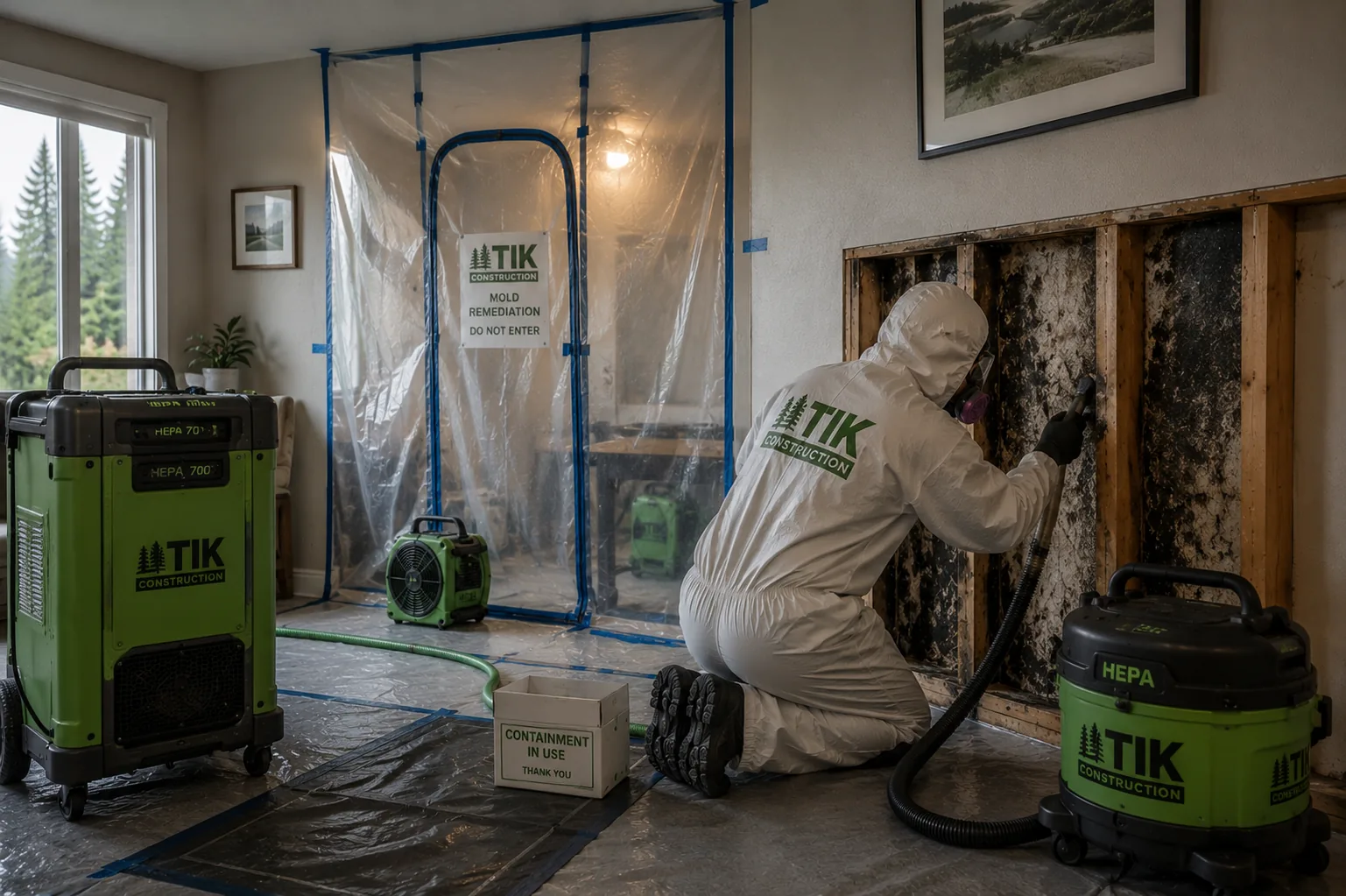
Crawl Space Mold Removal work by TIK Construction

Crawl space mold — why PNW crawl spaces grow it

Most Clark County and Portland-area homes sit over vented crawl spaces — a foundation design that was standard here for decades. The dirt floor releases ground moisture into the space year-round, and the vents that were supposed to dry it out often do the opposite in our climate: through the long wet season they pull in outdoor air that's already near saturation. That moisture condenses on cool wood framing, and mold grows on floor joists, beams, subfloor, and the paper facing of fiberglass insulation.

Crawl space mold matters upstairs because of how air moves through a house. Warm air rising through the living space draws replacement air upward from below — through gaps around plumbing, ducts, and the subfloor itself. Air from the crawl space becomes part of the air you breathe in the house. That's why the classic symptoms are indoor: a musty smell that's strongest in winter with the windows closed, allergy flare-ups at home, and sometimes cupping hardwood floors from moisture coming up through the subfloor.

Remediation under a house is its own discipline. The workspace is tight, the growth is often spread across the entire underside of the subfloor, and fallen insulation hides both mold and moisture problems. We work it in full PPE under IICRC S520 protocols: contaminated insulation and debris removed, framing HEPA-vacuumed and treated with antimicrobial — with abrasive cleaning where growth is embedded in the wood grain — and then the part that makes it last: ground-moisture control with sealed vapor barriers, drainage correction, and encapsulation where the space warrants it.


What causes crawl space mold in local homes

  • Missing, torn, or undersized vapor barriers

    A bare dirt floor releases water vapor into the crawl space continuously. Many older Clark County homes have no ground cover at all, or a thin sheet that's torn and displaced. Without a sealed barrier, the space never dries.

  • Wet-season ground water and poor drainage

    Sustained winter rain raises ground moisture, and lots with flat grading or short downspouts send roof water straight along the foundation. Standing water under the house during January is something we see every year — and mold follows it.

  • Humid outside air condensing on cool framing

    Vented crawl spaces breathe outdoor air, which in a Vancouver winter is cold and near saturation. When it meets framing and ducts, condensation forms and keeps wood damp for months at a time — ideal mold conditions.

  • Plumbing leaks under the house

    Supply and drain lines run through the crawl space, and a slow leak down there can drip unseen for months. The mold patch around a leaking fitting is often the clue that finds the leak.

  • Dryer vents and bath fans discharging into the crawl space

    Ducts that were never run to the exterior dump warm, moist air directly under the house — effectively humidifying the crawl space on purpose. It's a common shortcut in older remodels, and it grows mold reliably.

Don't wait. Damage compounds with every hour.

We're on the way day or night.

Our crawl space mold removal process

Crawl space jobs succeed or fail on the moisture correction. Cleaning the joists without fixing the ground moisture buys a year or two; fixing both ends the problem.

  1. First visit

    Full crawl space inspection

    A tech goes under the house with moisture meters, a camera, and lights — documenting the growth extent, insulation condition, vapor barrier state, drainage patterns, and any plumbing or duct issues. You see the photos; most homeowners never have. The findings drive the scope and any insurance documentation.

  2. Day 1

    Setup and containment at the access

    Crews work in full PPE. The crawl space access is sealed and a HEPA-filtered negative air machine keeps spores from migrating into the living space while material is removed through the opening.

  3. Days 1–2

    Removal of contaminated insulation and debris

    Moldy and fallen fiberglass insulation, stored debris, and damaged vapor barrier material are bagged and removed. This alone often reveals the true extent of both the growth and the moisture problem.

  4. Days 2–4

    Cleaning and treating the framing

    Joists, beams, and subfloor are HEPA-vacuumed and treated with antimicrobial. Where growth is embedded in the wood surface, we use abrasive methods — sanding or media blasting — to remove it rather than paint over it. Structural wood stays; surface growth goes.

  5. Days 3–5

    Moisture correction

    A sealed heavy-gauge vapor barrier goes over the ground, seams overlapped and taped. Drainage problems get corrected — downspout extensions, grading guidance, or a crawl space drain and sump where water collects. For chronically wet spaces we scope full encapsulation with a dehumidifier.

  6. Days 4–6

    Reinsulation and verification

    New insulation is installed where it was removed, moisture readings confirm the space is trending dry, and we do a final documented walkthrough of the work — photos again, so you can see the finished space without going under the house.

Prevention

How to prevent it next time

  • Keep the vapor barrier intact

    Ground cover only works when it covers the ground. After any trade works under the house — plumbers, electricians, HVAC — check that the barrier was put back in place.

  • Move roof water away from the foundation

    Clean gutters and downspout extensions that discharge several feet from the house keep the wet-season water table around your foundation lower. It's the cheapest crawl space moisture fix there is.

  • Never vent appliances into the crawl space

    Dryer vents and bathroom fans must terminate outside. If you can see a flex duct disappearing under the house, have it rerouted.

  • Look under the house every fall

    A ten-minute flashlight check at the access — or a camera on a pole — catches standing water, fallen insulation, and new growth before winter makes it worse. Musty smells upstairs are the other early warning worth acting on.

Real reviews

What customers say about TIK's mold remediation work

5★ average from 50+ verified Google reviews

  • "Elmer and his crew have been great. I appreciate their professionalism and the way they communicate with me. Very friendly, and seemed to be very skilled. I would highly recommend TIK for any of your projects!"

    Jeanne Fink

    Verified Google Review

  • "Tik Construction has been great to work with! Isaac and his team have been so professional and friendly. The communication has been clear and their timelines are well managed. If you need high quality work, TIK will always deliver!! A+++"

    Simply Contents Northwest

    Verified Google Review

  • "Isaac and his crew were amazing to work with, and the quality of work and customer service was outstanding!"

    Darin McConnell

    Verified Google Review

Insurance handled

We work directly with all major homeowner carriers. We document the damage, submit the claim within 24 hours, and bill direct so you pay only your deductible.

See carrier-specific claim details →

  • State Farm logo
  • Allstate logo
  • USAA logo
  • Liberty Mutual logo
  • Farmers logo
  • Travelers logo
  • American Family logo
  • Nationwide logo
  • Chubb logo
  • Progressive logo

Crawl space mold FAQs

How do I know if I have mold in my crawl space?

The usual signs show up inside the house: a musty odor that's strongest in winter when the home is closed up, allergy symptoms that improve when you leave, or cupping hardwood floors. Under the house, look for dark or white growth on joists, fallen insulation, and standing water. If you smell it but can't see it, an inspection with moisture readings settles it.

Does crawl space mold really affect the air upstairs?

Yes. Warm air rising through the house draws air upward from the crawl space through gaps around plumbing, ducting, and the subfloor. Air from under the house becomes part of the indoor air. That's why crawl space mold produces symptoms in the living space even though you never see the growth.

There's white fuzzy stuff on my floor joists — is that mold?

Often, yes — white and light-colored molds are common on crawl space framing. On concrete and masonry, a white crystalline deposit may instead be efflorescence, which is mineral salt left by evaporating moisture, not mold. Either way it's evidence of a moisture problem, and an inspection identifies which one you have.

Do I need full crawl space encapsulation?

Not always, and we won't sell it to you reflexively. Many crawl spaces stay dry with a sealed vapor barrier and corrected drainage. Encapsulation — sealed liner, closed vents, dehumidifier — is the right call for chronically wet spaces or homes with recurring mold. We scope what the moisture readings justify.

Will insurance cover crawl space mold removal?

It follows the cause. Mold from a sudden covered event — a supply line that burst under the house — is typically covered, and we bill the carrier directly. Mold from gradual ground moisture and drainage issues generally isn't, or is capped by a mold limit on the policy. We document the cause honestly so the claim reflects what happened.

How long does crawl space mold removal take?

Most crawl space remediations run 3–6 working days depending on the size of the space, how much insulation needs replacement, and the extent of the moisture correction. Encapsulation adds time. You can live in the home normally throughout — the work happens under it.

Musty smell upstairs? The problem is under the house.

Inspected with photos, remediated at the source, moisture corrected so it stays fixed.

Available 24/7 · Day or night · Every day of the year

Get help with crawl space mold removal

Send your info and we'll call you right back, day or night.

For emergencies, call us directly: (360) 938-4601

Call Now: (360) 938-4601