TIK Construction

SEWAGE CLEANUP · VANCOUVER WA + PORTLAND OR · BIOHAZARD CERTIFIED · 24/7

Sewage Cleanup in Vancouver WA — Biohazard-Certified Crews

TIK handles sewage cleanup under Category 3 water and biohazard protocols. We arrive in PPE, contain the affected area, extract contaminated water, sanitize surfaces with appropriate disinfectants, remove materials that can't be safely cleaned, dry the structure, and rebuild. IICRC S540 certified. Insurance billed direct.

  • IICRC Certified
  • Licensed WA + OR
  • All Major Insurance
  • 24/7
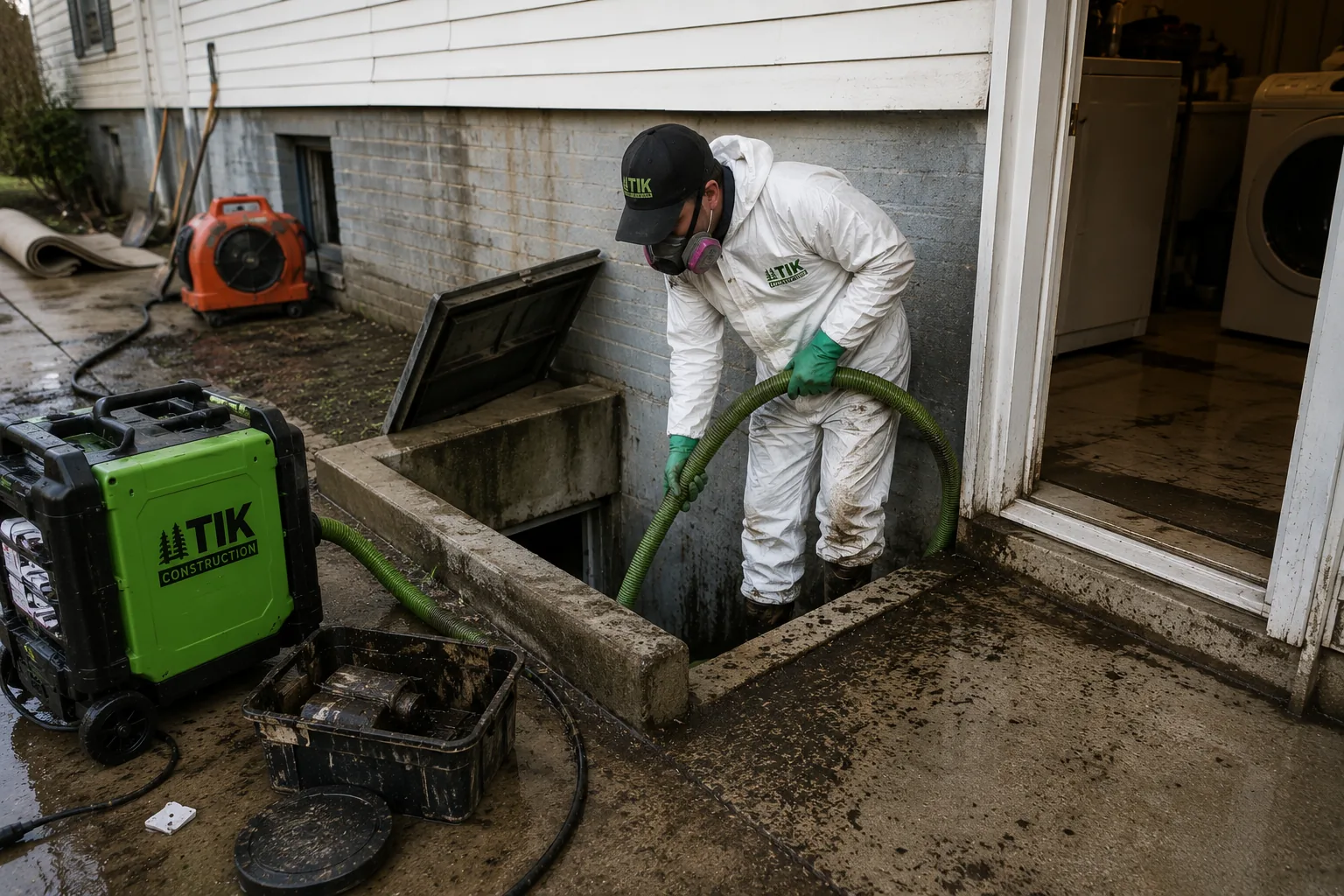
Sewage Cleanup work by TIK Construction

Response time

60 minutes

Availability

24/7, every day

Service area

Vancouver + Portland metro

Certifications

IICRC · Licensed WA + OR

Call us

(360) 938-4601

What is sewage cleanup?

Sewage cleanup is the specialized restoration of properties affected by sewage backup, septic failure, or other Category 3 water events. Sewage water contains bacteria, viruses, and pathogens that pose serious health risks. Cleanup follows different protocols than ordinary water damage — specifically IICRC S540 (trauma and biohazard cleanup) and IICRC S500 Category 3 protocols.

The work involves containment, contaminated water extraction, sanitization, structural drying, removal of porous materials that can't be decontaminated, and rebuild. Porous materials (drywall, carpet, padding, contaminated insulation, particleboard) cannot be cleaned to safe levels and must be removed. Non-porous surfaces (sealed concrete, tile, finished wood) can be cleaned and disinfected.

Sewage events are emergencies in a way ordinary water damage isn't. Pathogens multiply, the affected area is unsafe to enter without PPE, and the longer contamination sits the wider the cleanup zone becomes. Time-sensitive isn't a marketing line for sewage — it's a public-health reality.

We're IICRC S540 certified for trauma and biohazard work and carry the equipment and PPE needed for safe Category 3 work. Insurance carriers have specific documentation requirements for biohazard claims; we know them and meet them.

When to call for sewage cleanup

Sewage events are emergencies. Don't enter the affected area; call us first.

  • Sewer line backups

    Main sewer line backups push raw sewage into floor drains, toilets, and showers. We respond, contain, extract, and decontaminate.

  • Septic system failures

    Septic backups produce the same Category 3 water as sewer backups but often with higher organic load. We handle both and coordinate with septic services for the underlying repair.

  • Toilet overflows (Category 3)

    Toilet overflows from the trap or beyond contain Category 3 water. Even small overflows require proper biohazard protocols on porous materials.

  • Flood water (Category 3)

    Flood water from outside sources is Category 3 by definition — it carries soil pathogens, agricultural runoff, and possible sewage cross-contamination. We treat all flood water as biohazard.

  • Long-sitting Category 2 water

    Water that started as Category 2 (gray water) becomes Category 3 after sitting more than 48 hours due to bacterial growth. We assess and treat at the appropriate category on arrival.

  • Crawl space sewage

    Sewage in crawl spaces is one of the worst-case scenarios — confined space, limited ventilation, and direct contact with structural framing. We handle the cleanup with appropriate PPE and ventilation.

Our sewage cleanup process

Sewage cleanup follows tighter protocols than ordinary water damage. Skipping steps creates health risks that don't reveal themselves until weeks or months later.

  1. Hour 0–1

    Emergency dispatch in PPE

    We arrive within 60 minutes in full PPE — Tyvek suits, respirators, gloves, eye protection. Before any cleanup, we assess the scope, identify the source, document for insurance, and establish containment to prevent the contaminated area from spreading.

  2. Hour 1–6

    Containment and extraction

    Plastic sheeting and zipper doors isolate the affected area. We extract contaminated water with dedicated extraction equipment that gets cleaned with bleach solution between jobs. Truck-mounted extractors stay outside the contaminated zone.

    Equipment: Tyvek suits, respirators, dedicated extraction equipment, plastic sheeting, biohazard waste bags.

  3. Day 1

    Removal of contaminated materials

    Porous materials in contact with sewage cannot be safely decontaminated and are removed: drywall (typically 24 inches above the contamination line), carpet and padding, contaminated insulation, particleboard, soft furnishings. Materials are double-bagged as biohazard waste and disposed of per regulations.

  4. Days 1–2

    Sanitization

    Non-porous surfaces (sealed concrete, finished wood, tile) are cleaned and disinfected with hospital-grade antimicrobial. Multiple applications with appropriate dwell times. Surfaces are HEPA-vacuumed before disinfection to remove particulate contamination.

  5. Days 2–7

    Structural drying

    Industrial dehumidifiers and air movers dry the structure to IICRC S500 standards. Drying is monitored daily with moisture meters. The contained air is HEPA-filtered throughout drying.

  6. Days 5–10

    Verification and reconstruction

    Surface ATP testing or microbial sampling can verify decontamination if needed (and is documented for insurance). Then we rebuild — new drywall, insulation, flooring, paint. Same crew, no second contractor.

Ready when you are.

60-minute response. Call any time, day or night.

What makes TIK different for sewage cleanup

  • 01

    S540 biohazard certified

    Sewage cleanup requires IICRC S540 protocols and PPE. Many restoration companies treat Category 3 water as if it's ordinary water — and produce work that looks done but isn't safe. We do it right.

  • 02

    Dedicated equipment for biohazard

    Equipment used on Category 3 jobs gets specific decontamination procedures between jobs. We don't use the same extraction wand on a sewage job and your kitchen the next day.

  • 03

    Insurance documentation that gets approved

    Biohazard claims have specific carrier documentation requirements. We meet them every time, which is why our claims are approved without dispute.

  • 04

    Reconstruction included

    After decontamination and drying comes rebuild. We handle drywall, paint, flooring, finishes — the same way we do for water damage and fire jobs.

Real reviews

What customers say about TIK's sewage cleanup

4.9★ average from 50+ verified Google reviews

  • "TIK Construction and Restoration was great to work with. They showed up on time and did an excellent job cleaning up our little disaster we had in our laundry room. Would recommend them every time."

    Brandon Burns

    Verified Google Review

  • "We had a dishwasher leak that caused some damage, and TIK Construction and Restoration handled everything really well. The crew was quick, organized, and knew exactly what they were doing. Everything turned out great, and the whole process was way less stressful than we expected. Would definitely use them again."

    Nick

    Verified Google Review

  • "Elmer and David are reliable and dependable. They are prompt, efficient and responsive to our needs. We had a water mitigation issue and Elmer and David communicated with transparency what the issues were and how they could help. I appreciate their guidance and their customer service!"

    Deborah Moore

    Verified Google Review

Working with your insurance for sewage cleanup

Most homeowner policies cover sudden sewage backups when caused by a covered event (city sewer main backup, septic line failure). Some policies require a specific sewer-backup endorsement. We document the source and submit the claim.

We work with all major carriers: State Farm, Allstate, USAA, Liberty Mutual, Farmers, Travelers, American Family, Nationwide, Chubb, Progressive, and most regional carriers. About 85% of our jobs are insurance claims; the rest are private-pay.

How the claim process works: 1) We document damage on first arrival. 2) We submit documentation to your carrier within 24 hours. 3) The adjuster reviews and typically approves within 1–3 business days. 4) We perform the work. 5) We submit final documentation. 6) The carrier pays us directly. You pay only your deductible.

  • State Farm logo
  • Allstate logo
  • USAA logo
  • Liberty Mutual logo
  • Farmers logo
  • Travelers logo
  • American Family logo
  • Nationwide logo
  • Chubb logo
  • Progressive logo

Frequently asked questions about sewage cleanup

Is sewage water dangerous to my health?

Yes. Sewage water (Category 3) contains bacteria, viruses, and pathogens that cause gastrointestinal illness, respiratory infections, and skin infections. Direct contact, ingestion (even microscopic amounts via contaminated air), and contact with broken skin all pose risks. Don't enter a sewage-contaminated area without PPE — call us instead.

Will my insurance cover sewage cleanup?

Most homeowner policies cover sudden sewage backups when caused by a covered event (e.g., a city sewer main backup, a septic line failure). Some policies require a specific 'sewer backup' endorsement. We document the source and submit the claim. Most carriers approve sewage backup claims when documentation is complete.

Can you save my carpet, flooring, and walls after a sewage event?

Porous materials in contact with sewage water — carpet, padding, drywall (typically 24 inches above contamination), insulation, particleboard — can't be safely decontaminated and must be removed. Non-porous surfaces (sealed concrete, tile, finished hardwood) can be cleaned and disinfected.

How long does sewage cleanup take?

Initial cleanup and decontamination typically takes 3–5 days. With reconstruction, total timeline is usually 2–4 weeks depending on scope. We give an honest estimate after assessment.

Do I need to leave my home during sewage cleanup?

For limited contamination in a single area, you can usually stay in unaffected parts of the home. For larger sewage events, temporary lodging is recommended for safety — your insurance typically covers this. We'll tell you upfront based on the scope.

What about smell after sewage cleanup?

Properly executed sewage cleanup eliminates odor at the source. We use enzymatic treatment, antimicrobial, and ventilation to neutralize odor — not just mask it. If odor persists after our work, contamination wasn't fully removed; we come back and finish.

Don't wait. Sewage events are public-health emergencies.

60-minute response in full PPE. Insurance handled. IICRC S540 certified.

Available 24/7 · Day or night · Every day of the year

Get sewage cleanup help

Send your info and we'll call within 30 minutes.

For emergencies, call us directly: (360) 938-4601

Call Now: (360) 938-4601