TIK Construction

MOLD REMEDIATION · VANCOUVER WA + PORTLAND OR · IICRC AMRT CERTIFIED

Mold Remediation in Vancouver WA — IICRC and AMRT Certified

TIK handles mold remediation from initial assessment through post-remediation verification. We follow IICRC S520 protocols — full containment, HEPA filtration, removal of affected materials, antimicrobial treatment, and air-quality verification. Pacific Northwest homes are mold-prone; doing the work right matters.

  • IICRC Certified
  • Licensed WA + OR
  • All Major Insurance
  • 24/7
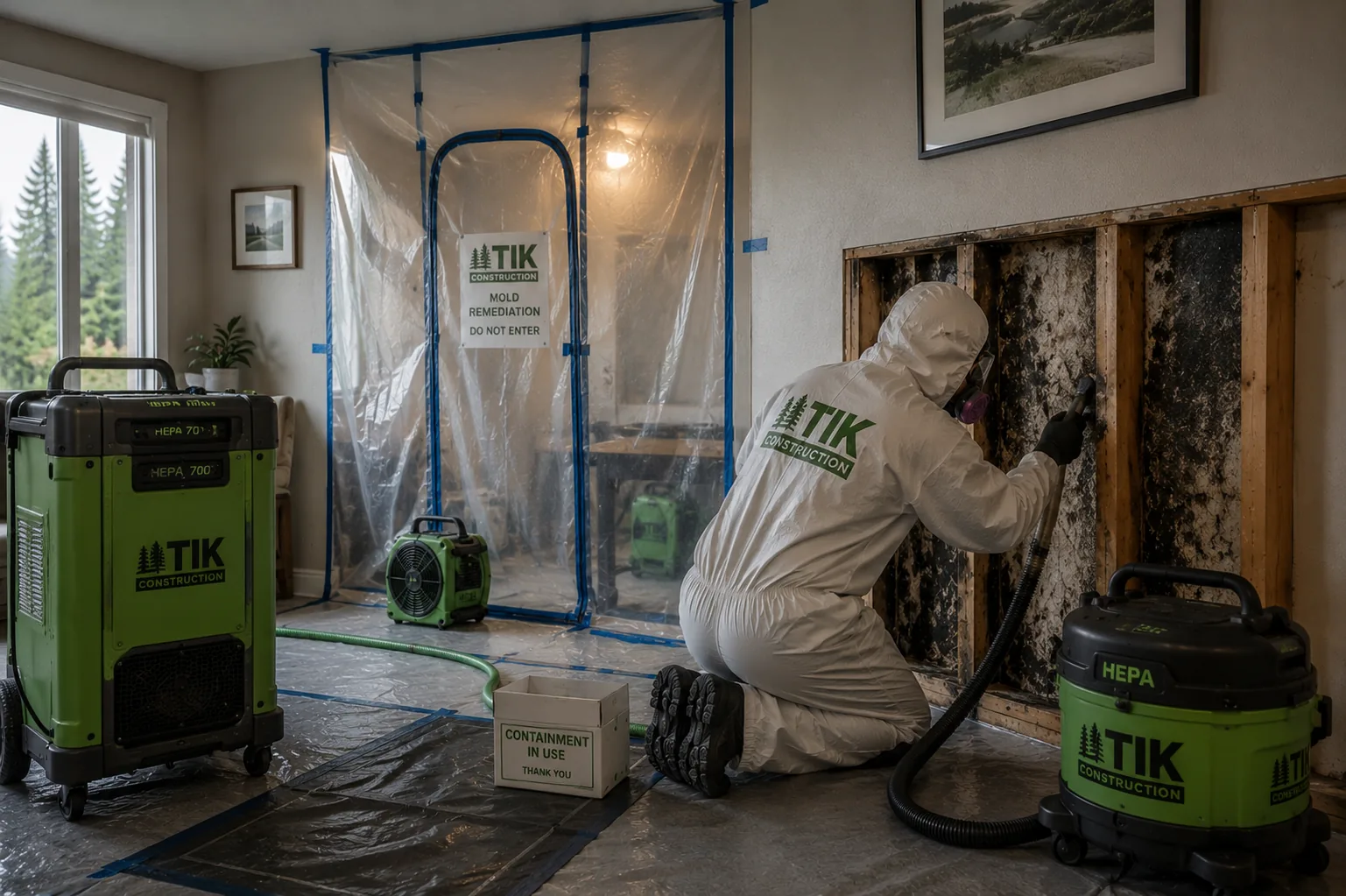
Mold Remediation work by TIK Construction

Response time

60 minutes

Availability

24/7, every day

Service area

Vancouver + Portland metro

Certifications

IICRC · Licensed WA + OR

Call us

(360) 938-4601

What is mold remediation?

Mold remediation is the controlled process of removing mold growth, addressing the moisture source that allowed it to grow, and verifying the affected area is free of mold spores at the end. It's not the same as mold cleaning — surface cleaning removes visible mold but leaves spores in the air and the moisture conditions that caused the problem. Remediation addresses the root cause.

The work follows IICRC S520, the industry standard for mold remediation. Containment is set up first — physical barriers (plastic sheeting, zipper doors) and negative-pressure air control (HEPA-filtered air scrubbers) prevent spores from spreading to clean parts of the home during removal. Affected materials are bagged and removed under containment. Surfaces are HEPA-vacuumed, then cleaned with antimicrobial. The moisture source is identified and corrected — without that, mold returns.

Pacific Northwest homes are particularly mold-prone. Our climate produces sustained high humidity for much of the year, and many older homes in Clark County and Portland have crawl spaces, basements, and bathroom configurations that hold moisture. Mold isn't a sign of negligence — it's a routine consequence of the climate when moisture conditions exist. The right response is remediation, not embarrassment.

Most importantly: small mold problems don't always stay small. Mold spreads through drywall, into wall cavities, into HVAC systems. By the time visible mold reaches a few square feet, hidden mold is often much larger. That's why we use thermal imaging and moisture meters during assessment — to find what's hidden behind the visible.


When to call for mold remediation

If you see mold or smell that distinctive musty odor, call. Don't disturb visible mold — disturbance releases spores.

  • Visible black mold

    Black mold (often Stachybotrys chartarum) is one of several mold species that signals chronic moisture. We test, contain, and remove it under IICRC S520 protocols.

  • Bathroom mold (around tubs, in grout, on ceilings)

    Bathrooms accumulate mold from chronic humidity. We address surface mold and identify the underlying ventilation or sealing issue causing it.

  • Basement mold

    Basements are mold-prone due to humidity, low temperatures, and sometimes groundwater intrusion. We remediate the mold and address the moisture source.

  • Attic mold

    Attic mold typically signals roof leaks, inadequate ventilation, or condensation issues. We remediate the mold and identify the underlying cause for repair.

  • Crawl space mold

    Crawl spaces in PNW homes are common mold sites due to ground moisture and limited airflow. We remediate and recommend vapor barriers or encapsulation as appropriate.

  • Mold discovered during renovations

    Hidden mold inside walls or under flooring discovered during renovation requires immediate containment. We pause your renovation, remediate the mold, and you continue with the renovation cleanly.

Our mold remediation process

Every mold remediation job at TIK follows IICRC S520 protocols. Skipping containment or post-remediation verification produces a job that looks done but isn't.

  1. Hour 0–24

    Initial assessment and air-quality testing

    We assess visible mold, use thermal imaging and moisture meters to find hidden mold, and (for larger jobs) take air-quality samples to identify spore concentration before work begins. The assessment is the basis for the remediation plan and the insurance documentation.

  2. Day 1

    Containment setup

    Physical barriers (plastic sheeting, zipper doors) isolate the affected area from the rest of the home. HEPA-filtered air scrubbers create negative pressure inside the containment so air flows in, not out. This prevents spores from spreading during removal.

    Equipment: Plastic sheeting, zipper doors, HEPA air scrubbers (negative air machines), respirators, Tyvek suits.

  3. Days 1–3

    Removal of mold-contaminated materials

    Materials too contaminated to clean (porous drywall, insulation, carpet padding) are removed under containment, double-bagged, and disposed of as regulated waste. Non-porous materials (framing, sub-flooring) are HEPA-vacuumed and treated with antimicrobial. We don't remove what can be cleaned and don't try to clean what should be removed.

  4. Days 2–4

    HEPA cleaning and antimicrobial treatment

    All surfaces inside containment are HEPA-vacuumed (regular vacuums redistribute spores). Then surfaces are wiped with antimicrobial. The contained air is HEPA-scrubbed continuously throughout this phase to capture any disturbed spores.

  5. Days 3–5

    Moisture source correction

    Mold grows because moisture is present. Without addressing the moisture source, mold returns. We identify the source — chronic humidity, a leak, ventilation deficit, condensation — and correct it as part of the remediation, or coordinate the correction with the appropriate trade.

  6. Days 4–6

    Post-remediation verification

    Air samples are retaken and compared to outdoor controls. If spore counts inside containment are at or below outdoor levels, the remediation is verified. If not, we extend HEPA scrubbing and re-test. Containment is removed only after verification.

  7. Weeks 1–3

    Reconstruction

    We rebuild what was removed — drywall, insulation, flooring, paint. Matching existing finishes. Same crew, no second contractor.

Ready when you are.

60-minute response. Call any time, day or night.

What makes TIK different for mold remediation

  • 01

    AMRT-certified, S520-compliant

    Our techs hold IICRC AMRT (Applied Microbial Remediation Technician) certification and follow the S520 standard. We don't shortcut containment, HEPA filtration, or post-remediation verification.

  • 02

    We address the moisture source

    Mold grows because moisture is present. Remediation without correcting the moisture source is a temporary fix at best. We identify and address the source as part of every job.

  • 03

    Reconstruction included

    After remediation comes rebuilding what was removed — drywall, paint, insulation, flooring. We do both. One company, one warranty.

  • 04

    Honest assessments

    Some moisture issues are mold; some are just moisture. Some 'mold' is mildew that doesn't need full remediation. We test before recommending and don't oversell jobs that don't warrant remediation.

Real reviews

What customers say about TIK's mold remediation

4.9★ average from 50+ verified Google reviews

  • "Elmer and his crew have been great. I appreciate their professionalism and the way they communicate with me. Very friendly, and seemed to be very skilled. I would highly recommend TIK for any of your projects!"

    Jeanne Fink

    Verified Google Review

  • "Tik Construction has been great to work with! Isaac and his team have been so professional and friendly. The communication has been clear and their timelines are well managed. If you need high quality work, TIK will always deliver!! A+++"

    Simply Contents Northwest

    Verified Google Review

  • "Isaac and his crew were amazing to work with, and the quality of work and customer service was outstanding!"

    Darin McConnell

    Verified Google Review

Working with your insurance for mold remediation

Mold coverage depends on the cause — sudden, covered events (burst pipes, fire suppression) are typically covered, while gradual moisture issues are often capped. We document the cause precisely so the right amount of coverage applies.

We work with all major carriers: State Farm, Allstate, USAA, Liberty Mutual, Farmers, Travelers, American Family, Nationwide, Chubb, Progressive, and most regional carriers. About 85% of our jobs are insurance claims; the rest are private-pay.

How the claim process works: 1) We document damage on first arrival. 2) We submit documentation to your carrier within 24 hours. 3) The adjuster reviews and typically approves within 1–3 business days. 4) We perform the work. 5) We submit final documentation. 6) The carrier pays us directly. You pay only your deductible.

  • State Farm logo
  • Allstate logo
  • USAA logo
  • Liberty Mutual logo
  • Farmers logo
  • Travelers logo
  • American Family logo
  • Nationwide logo
  • Chubb logo
  • Progressive logo

Frequently asked questions about mold remediation

Is the mold in my house dangerous?

Some mold species (notably Stachybotrys, sometimes called black mold) produce mycotoxins that can cause health issues, especially for people with respiratory conditions, allergies, or compromised immune systems. Even non-toxic molds aggravate asthma and allergies. The right response is remediation, not panic — but ignoring visible mold isn't safe.

Can I just clean the mold myself with bleach?

For small surface mold (a few square feet on non-porous surfaces, like bathroom tile), DIY cleaning with appropriate cleaners can work. For mold larger than ~10 square feet, mold on porous materials (drywall, insulation), or mold with an unknown source — call professionals. Disturbing mold without containment releases spores throughout the home.

Will my insurance cover mold remediation?

Coverage depends on the cause. Mold caused by a sudden, covered event (burst pipe, fire suppression, storm damage) is typically covered. Mold caused by long-term, gradual moisture issues is often excluded or capped at a low limit (commonly $5,000–$10,000). We document the cause and submit the claim — most cause-related mold is approved.

How long does mold remediation take?

Most residential mold remediation takes 5–14 days from start to finish, including reconstruction. Larger jobs or jobs requiring crawl-space encapsulation can take longer. We give an honest timeline estimate after the assessment.

Will the mold come back?

Not if the moisture source is corrected. Mold returns when remediation cleans the surface but doesn't address why moisture was there in the first place. We identify and correct the source as part of every job — that's why our remediation work is durable.

Do I need to leave my home during remediation?

Usually no. Containment isolates the affected area, and HEPA filtration controls air quality inside containment. You can typically stay in unaffected areas of the home. For very large or whole-house jobs, temporary relocation may be needed — we'll tell you upfront.

Don't wait. Mold spreads quickly and threatens your health.

60-minute response, day or night. IICRC AMRT certified. Whole job under one roof.

Available 24/7 · Day or night · Every day of the year

Get mold remediation help

Send your info and we'll call within 30 minutes.

For emergencies, call us directly: (360) 938-4601

Call Now: (360) 938-4601