
Sewage Cleanup in West Linn, OR: what we see locally
West Linn sits on the west bank of the Willamette River directly across from Oregon City, at the confluence of the Willamette and Tualatin rivers about 10 miles south of Portland. The city is hilly and compact — about 7.4 square miles — with elevations running from roughly 20 feet along the riverbank up to 743 feet at its highest point, and Willamette Falls, the largest waterfall in the Pacific Northwest by volume, sits just across the river.
The city incorporated in 1913, combining several older waterfront communities — West Oregon City, Bolton, Sunset, and Willamette — that had grown up around 19th-century milling and paper operations at the falls. That gives West Linn's riverfront neighborhoods (Bolton, Sunset, Robinwood, Willamette) some of the oldest housing stock in the area, dating to the late 1800s and early 1900s. The hillside neighborhoods above — Barrington Heights/Hidden Creek/Tanner Creek (known locally as BHT), Skyline Ridge, Marylhurst, Rosemont Summit, and Savanna Oaks — filled in later, mostly from the 1980s through the 2000s, as development climbed the slopes away from the two rivers.
That split between old riverfront and newer hillside terrain shapes West Linn's water exposure. The steep grades above the falls and along the Tualatin mean stormwater and drainage depend heavily on graded lots and retaining walls rather than flat-ground runoff, and the city's own stormwater program tracks Tanner Creek — which drains the newer Tanner Basin development area — as one of its primary monitored drainage basins. Older riverfront homes closer to river grade see a different pattern: aging supply and drain lines from a housing stock that predates modern plumbing codes.
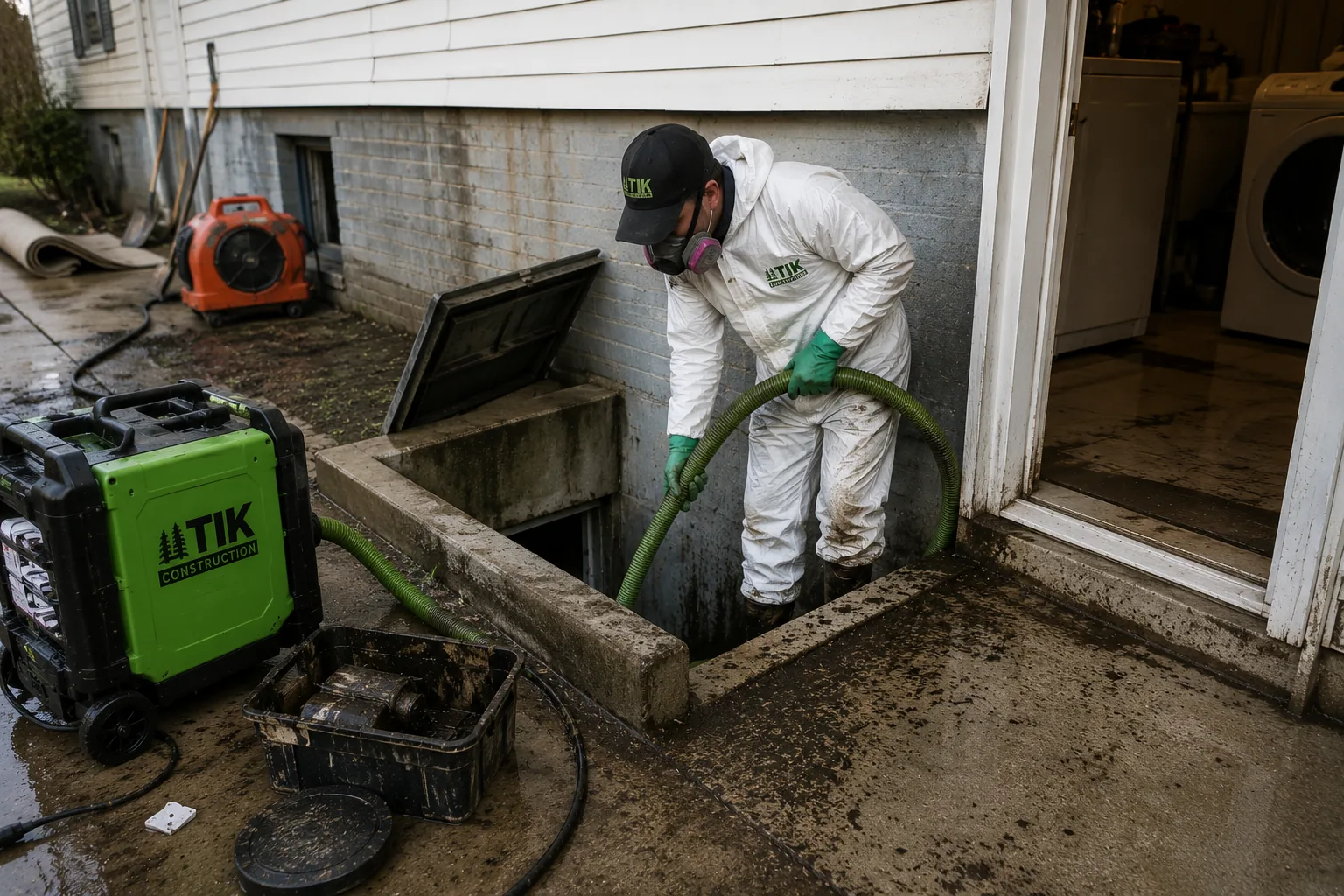
Typical sewage cleanup scenario in West Linn: West Linn runs on separated sewer and stormwater systems, but the oldest riverfront neighborhoods have aging lateral lines from the early 1900s that are more prone to root intrusion and backups than the newer hillside subdivisions' PVC laterals. We handle both with full Category 3 protocols.


