
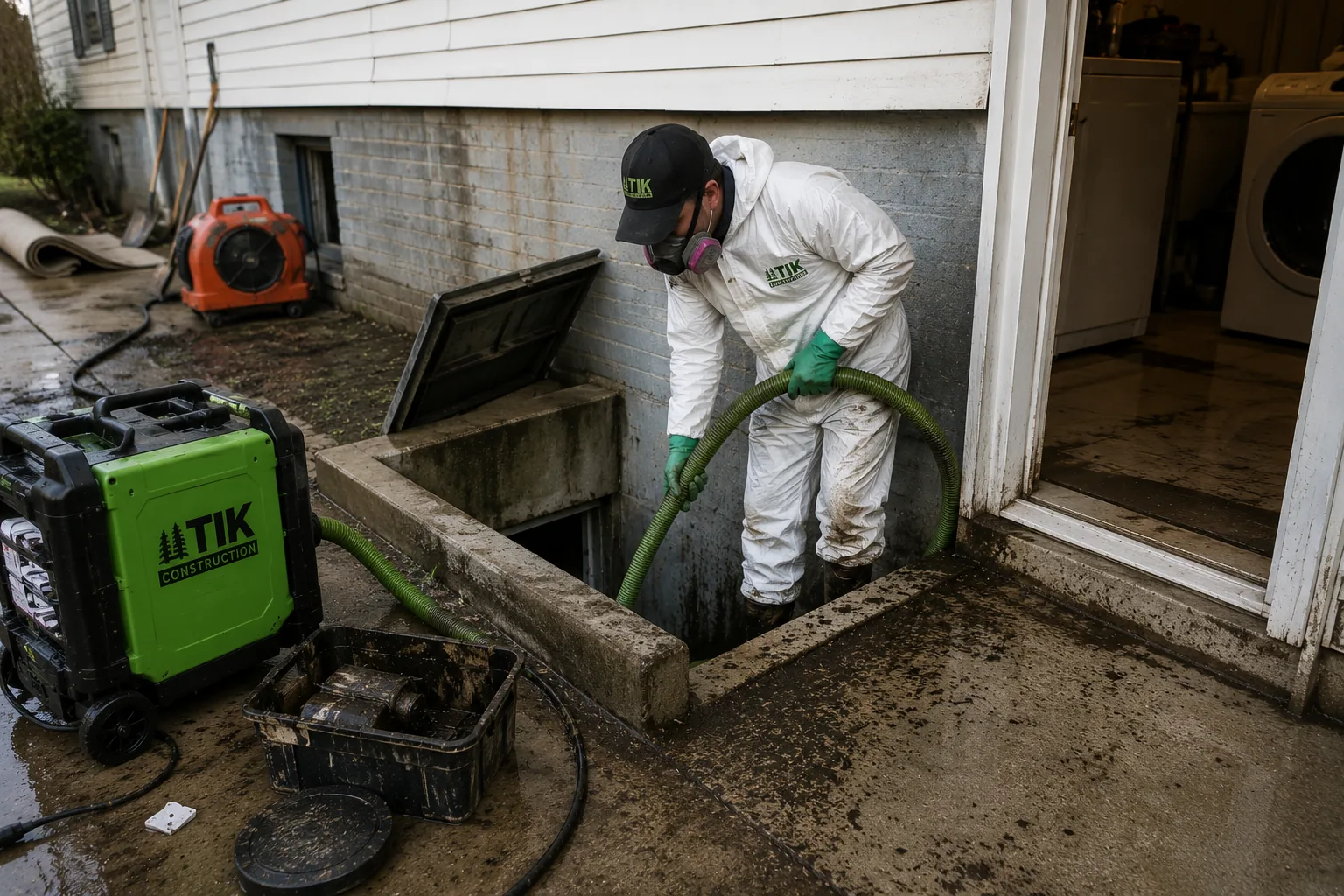
Sewage Cleanup in Brush Prairie, WA: what we see locally
Brush Prairie is an unincorporated community in Clark County, about 11 miles northeast of Vancouver — a census-designated place rather than an incorporated city, with no city government of its own. It's named for a "brushy prairie and swamp" on an early settler's land; a post office opened there in 1871. Roughly 2,700 people live across its 7.8 square miles, bordered by Meadow Glade and Battle Ground to the north, Hockinson to the east, Orchards and Five Corners to the south, and Barberton to the west.
Unlike the incorporated cities TIK serves, Brush Prairie has no municipal water or sewer system — private wells and septic systems are the standard across both older and newer properties. That single fact shapes most of the restoration calls we get here: a well-pump failure or a backed-up drainfield is a different job than a city-water leak or a municipal sewer backup, and it's the default here rather than the exception.
Housing is rural and acreage-driven. Roughly half the homes in the area sit on an acre or more, with lot sizes running from subdivision-scale parcels under a quarter-acre up to multi-acre farms and horse properties, mixed in with older farmhouses dating to the area's agricultural homestead era. Clark County maintains the local roads with roadside ditches and culverts rather than piped storm drains, and low points on NE 156th Street near NE 102nd Avenue and NE 112th Avenue are documented flood points during sustained heavy rain. The county-owned Chelatchie Prairie Railroad, a short line that runs north out of Vancouver, passes through the area.
Typical sewage cleanup scenario in Brush Prairie: Nearly every Brush Prairie property is on a private septic system rather than municipal sewer, so septic tank backups and drainfield failures — not city sewer-line backups — are the dominant sewage call here. Older, undersized systems on properties that have added bedrooms or outbuildings over the years are the most common failure point, and we handle the Category 3 cleanup the same way regardless of whether the source is a septic tank or a municipal line.


