
TIK Construction

BASEMENT SEWAGE BACKUP · VANCOUVER WA + PORTLAND OR · BIOHAZARD CERTIFIED

Basement Sewage Backup Cleanup in Vancouver WA — Contained and Decontaminated

A sewage backup in a finished basement contaminates everything the water touches — carpet, drywall, cabinetry, stored belongings. TIK arrives in full PPE, contains the affected area, extracts and disposes of contaminated materials under IICRC S540 protocols, sanitizes what can be saved, and rebuilds the space. Insurance billed direct.

  • IICRC Certified
  • Licensed WA + OR
  • All Major Insurance
  • 24/7
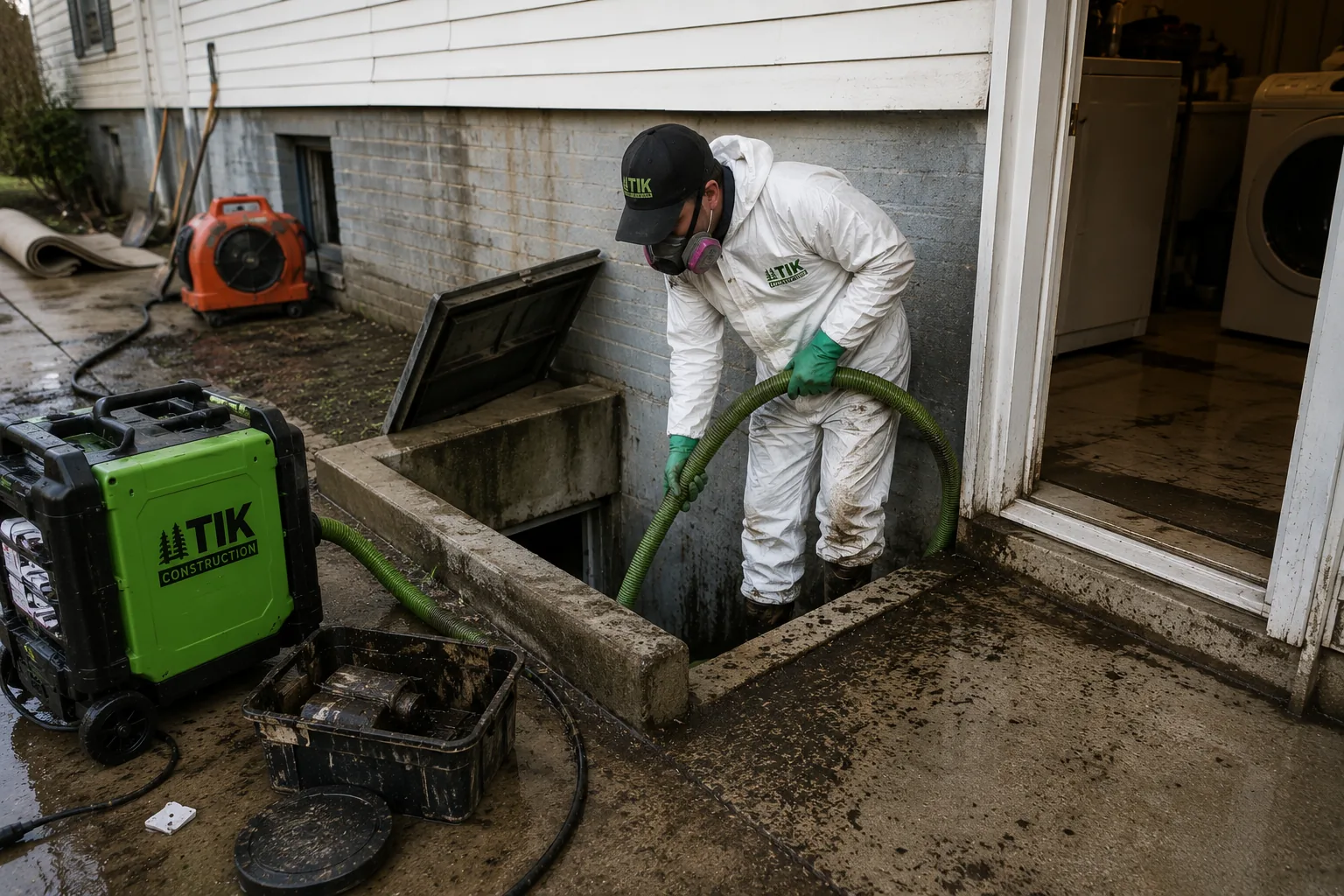
Basement Sewage Backup Cleanup work by TIK Construction

Basement sewage backups — why the basement takes the worst of it

Basements sit at the lowest point in a home's drainage system, which is exactly why they're where sewer backups show up first. When a main line clogs or a municipal sewer surcharges during heavy rain, wastewater has nowhere to go but back up through the lowest fixtures and floor drains in the house — almost always the basement. By the time it's noticed, Category 3 water has usually spread across the finished floor and soaked into whatever it touched.

The contamination profile is different from an ordinary basement flood. Sewage carries bacteria, viruses, and parasites, so porous materials that absorb it — carpet and padding, drywall, particleboard cabinetry, cardboard storage boxes — can't be cleaned to a safe standard and have to be removed rather than dried. Non-porous surfaces like sealed concrete and tile can be disinfected and kept. Sorting correctly between the two categories is the difference between a clean, safe basement and one that looks fine but still carries contamination inside the walls.

Vancouver and Portland metro basements back up for a few recurring reasons. Older neighborhoods with combined sewer and stormwater lines — common in parts of central Vancouver and inner Portland — see backups during sustained heavy rain when the shared system surcharges. Homes on separated systems more often back up from root intrusion or a collapsed section of the homeowner's own lateral line. Either way, the cleanup discipline is the same once sewage is in the house.


Common basement sewage backup causes

  • Combined sewer surcharge during heavy rain

    Older neighborhoods in central Vancouver and inner Portland share stormwater and sewage in the same pipe. During sustained heavy rain the system can exceed capacity and back up into the lowest fixtures in connected homes.

  • Tree root intrusion in the sewer lateral

    Roots find their way into aging clay or cast-iron lateral lines through joints and cracks, gradually narrowing the pipe until it backs up completely, often during periods of heavy household water use.

  • Collapsed or bellied lateral line

    Older lateral lines can settle, crack, or collapse over decades. A partial collapse traps solids and eventually blocks the line entirely, sending wastewater back into the house instead of out to the main.

  • Municipal main line blockage

    A blockage in the city's main sewer line downstream can back up into every connected home upstream of it, regardless of the condition of an individual homeowner's own plumbing.

  • Sump pump or ejector pump failure in homes with basement fixtures

    Basements with below-grade bathrooms often rely on an ejector pump to move waste up to the main line. A failed pump backs sewage up into the basement fixture it serves.

Don't wait. Damage compounds with every hour.

We're on the way day or night.

Our basement sewage backup cleanup process

Sewage cleanup follows tighter protocols than an ordinary basement flood. Skipping containment or the decontamination step creates a health hazard that looks cleaned up but isn't.

  1. Right away

    Dispatch in full PPE

    We dispatch the moment you call and arrive in Tyvek suits, respirators, and gloves. The lead tech assesses the scope and source before any cleanup begins, and containment goes up to keep the contaminated area from spreading to the rest of the basement.

  2. Hour 1–6

    Contaminated water extraction

    Dedicated extraction equipment reserved for biohazard work removes standing sewage water. Truck-mounted units stay outside the contaminated zone to avoid cross-contamination.

  3. Day 1

    Removal of contaminated materials

    Carpet and padding, drywall typically up to 24 inches above the contamination line, particleboard cabinetry, and any porous stored belongings are bagged as biohazard waste and disposed of per regulation. These materials cannot be safely decontaminated.

  4. Days 1–2

    Sanitization of salvageable surfaces

    Sealed concrete, tile, and finished wood are cleaned and disinfected with hospital-grade antimicrobial, HEPA-vacuumed first to remove particulate contamination before disinfectant is applied.

  5. Days 2–7

    Structural drying

    Industrial dehumidifiers and air movers dry the basement to IICRC S500 standards. Moisture readings are checked daily, and the contained air is HEPA-filtered throughout drying.

  6. Days 5–14

    Reconstruction

    New drywall, insulation, flooring, and paint rebuild the finished basement to match its prior condition. The same crew that decontaminated the space handles the rebuild.

Prevention

How to prevent it next time

  • Install a backwater valve

    A backwater valve on the main line closes automatically if sewage tries to flow backward, protecting the basement even if the municipal system surcharges. Common-sense insurance for homes on combined sewer lines.

  • Have the lateral line scoped periodically

    A camera inspection of the sewer lateral catches root intrusion and pipe settling before they cause a full backup. Worth doing on homes with mature trees near the line or original clay pipe.

  • Test ejector pumps regularly

    If a basement bathroom relies on an ejector pump, test it periodically the same way you'd test a sump pump. A failed ejector pump backs sewage straight into the fixture it serves.

  • Don't store porous items directly on a basement floor

    Cardboard boxes and untreated wood shelving on the floor are the first things a backup contaminates and the least likely to be saved. Elevate storage where a basement has any backup history.

Real reviews

What customers say about TIK's sewage cleanup work

5★ average from 50+ verified Google reviews

  • "TIK Construction and Restoration was great to work with. They showed up on time and did an excellent job cleaning up our little disaster we had in our laundry room. Would recommend them every time."

    Brandon Burns

    Verified Google Review

  • "We had a dishwasher leak that caused some damage, and TIK Construction and Restoration handled everything really well. The crew was quick, organized, and knew exactly what they were doing. Everything turned out great, and the whole process was way less stressful than we expected. Would definitely use them again."

    Nick

    Verified Google Review

  • "Elmer and David are reliable and dependable. They are prompt, efficient and responsive to our needs. We had a water mitigation issue and Elmer and David communicated with transparency what the issues were and how they could help. I appreciate their guidance and their customer service!"

    Deborah Moore

    Verified Google Review

Insurance handled

We work directly with all major homeowner carriers. We document the damage, submit the claim within 24 hours, and bill direct so you pay only your deductible.

See carrier-specific claim details →

  • State Farm logo
  • Allstate logo
  • USAA logo
  • Liberty Mutual logo
  • Farmers logo
  • Travelers logo
  • American Family logo
  • Nationwide logo
  • Chubb logo
  • Progressive logo

Basement sewage backup FAQs

Is it safe to go into a basement after a sewage backup?

Not without PPE. Sewage water carries bacteria, viruses, and parasites that pose real health risks through contact, inhalation, and contact with broken skin. Stay out and call us — we arrive equipped to assess and begin cleanup safely.

Will my insurance cover a basement sewage backup?

Many standard homeowner policies cover sewer backup only with a specific endorsement added to the policy. We document the cause and submit the claim; if the endorsement is in place, most sewage backup claims are approved without dispute.

Can my finished basement carpet and drywall be saved?

Generally no. Porous materials that absorb sewage — carpet, padding, drywall near the contamination line, particleboard cabinetry — can't be decontaminated to a safe standard and have to be removed. Sealed concrete, tile, and finished hardwood usually can be cleaned and kept.

How do I stop this from happening again?

It depends on the cause. A backwater valve protects against municipal system surcharges. A lateral line scope catches root intrusion or a collapsing pipe before it fails completely. We identify the likely cause during cleanup and can point you toward the right fix.

How long does basement sewage backup cleanup take?

Initial extraction and decontamination typically take 3–5 days. With full reconstruction of a finished basement, total timeline usually runs 2–4 weeks depending on scope. We give an honest estimate after the initial assessment.

Sewage in your basement? Stay out and call.

Rapid dispatch in full PPE. IICRC S540 certified. Insurance handled.

Available 24/7 · Day or night · Every day of the year

Get help with basement sewage backup cleanup

Send your info and we'll call you right back, day or night.

For emergencies, call us directly: (360) 938-4601

Call Now: (360) 938-4601