
TIK Construction

EMERGENCY ROOF TARP-OVER · VANCOUVER WA + PORTLAND OR

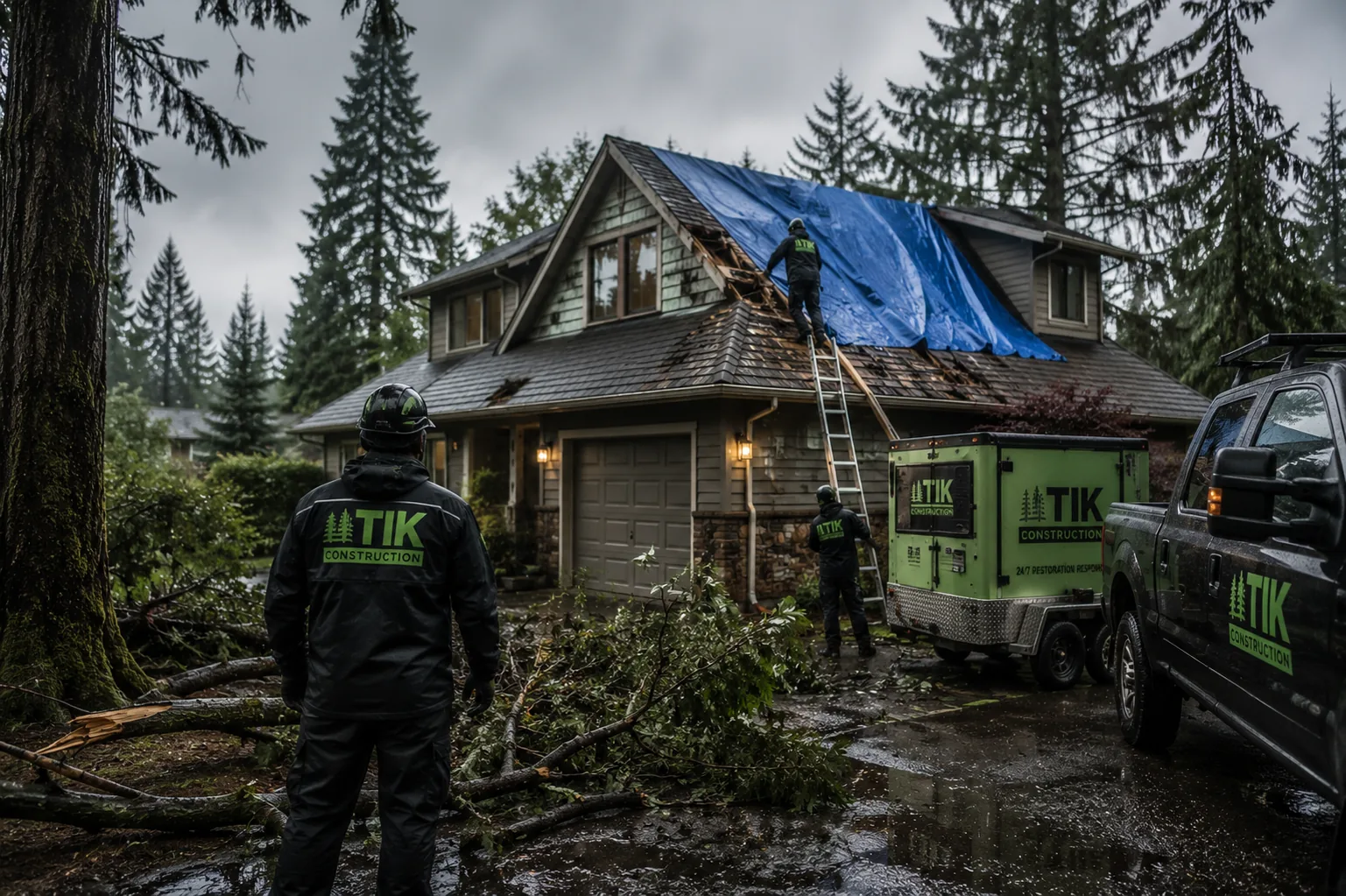
Emergency Roof Tarp-Over in Vancouver WA — Breach Closed Before the Next Rain

A roof opened by wind, a fallen limb, or missing shingles lets every subsequent rain event send more water into the attic and ceilings below. TIK secures a proper tarp-over the same visit when conditions allow, then handles the structural assessment, water mitigation, and permanent roof repair as one continuous job. Licensed general contractor in Washington and Oregon.

  • IICRC Certified
  • Licensed WA + OR
  • All Major Insurance
  • 24/7
Emergency Roof Tarp-Over work by TIK Construction

Emergency roof tarping — a stopgap that has to be done right

An emergency tarp-over is temporary weatherproofing over a roof breach — missing or torn-off shingles, a hole from a fallen limb, damaged flashing — done to stop water intrusion until permanent repair happens. It sounds simple, but a poorly secured tarp fails in the next windstorm and does almost nothing, while a properly installed one, battened down with furring strips and fastened well past the edges of the damage, holds through sustained Pacific Northwest wind and rain for weeks if needed.

The Vancouver and Portland metro's wet season makes tarping timing matter more than in drier climates. A breach that goes uncovered doesn't just risk one storm — it sits exposed to the region's long stretch of fall and winter rain, and every additional storm before a proper tarp goes on compounds attic, ceiling, and wall damage well beyond what the original wind or tree event caused. That's why we treat tarping as the priority the moment conditions are safe to work, ahead of any other assessment.

Not every tarp job is the same. A localized breach from a few missing shingles needs a smaller, more precisely placed tarp; a full tree strike or a torn-off section spanning multiple roof planes needs a larger tarp system anchored across ridges and valleys to shed water correctly rather than pool it. Getting the coverage and fastening wrong turns a temporary fix into a new leak source.


Common reasons a roof needs emergency tarping

  • Wind-torn or missing shingles

    Sustained gusts lift and tear away shingles, especially aging or already-loose ones, exposing the underlayment and decking directly to weather.

  • Tree limb or trunk strike

    A falling limb or full tree opens a hole straight through the roof deck, sometimes into the attic or living space below. These breaches need the largest and most carefully anchored tarps.

  • Damaged or lifted flashing

    Flashing around chimneys, vents, and valleys that's bent or torn loose in high wind creates a breach that's often smaller and less visible than a missing-shingle patch, but leaks just as readily.

  • Ridge cap and vent cover failures

    Ridge caps and vent covers torn loose in wind expose the roof's highest and most vulnerable points, where water intrusion travels furthest into the attic before it's noticed.

  • Storm debris impact

    Wind-driven debris — branches, fence sections, neighboring structure fragments — can puncture or crack roofing material even without a full tree strike.

Don't wait. Damage compounds with every hour.

We're on the way day or night.

Our emergency roof tarping process

Tarping has to happen fast and hold through the next storm, but rushing the install without proper anchoring and edge coverage just creates a second leak. We do it right the first time, then move to the permanent repair.

  1. Right away

    Dispatch and hazard assessment

    We dispatch as soon as you call. During active severe weather, crew safety affects timing, but tarping becomes the priority the moment conditions allow a crew to work safely on the roof.

  2. On arrival

    Breach measurement and tarp sizing

    The lead tech measures the full extent of the breach — not just the visible hole, since wind damage often extends past what's obvious from the ground — and selects a tarp sized to cover well past the damage edges.

  3. On arrival

    Tarp installation and anchoring

    The tarp is secured with furring strips and fasteners into solid roof decking, extended over ridgelines where needed so water sheds off the tarp rather than pooling against it, and checked for wind resistance before the crew leaves.

  4. Hour 4–24

    Structural assessment and water mitigation

    Once the breach is covered, we assess roof framing and decking for damage, and extract and dry any water that already got in before the tarp went up. Everything is documented for the insurance claim.

  5. Days 1–5

    Permanent roof repair scheduling

    We schedule the actual roofing repair or replacement, coordinating with roofing trades as needed for larger jobs, so the tarp stays in place only as long as it takes to do the permanent fix right.

  6. Days 3–14

    Interior repair and rebuild

    Any interior water damage from before the tarp went on — ceiling drywall, insulation, framing — gets rebuilt and matched to existing finishes as part of the same project.

Real reviews

What customers say about TIK's storm damage restoration work

5★ average from 50+ verified Google reviews

  • "We called TIK when we woke up (on a weekend!) to a major leak in our living room from the upstairs tub. Elmer mobilized right away and got to us within a couple hours to begin the water mitigation. He is now helping us communicate with our insurance representative and take the next steps in the water restoration. We appreciate all the help we've gotten from TIK during this difficult event!"

    Grace D.

    Verified Google Review

  • "We can trust Tik to get the job done right the first time and on time!"

    Danielle Doucet

    Verified Google Review

  • "TIK Construction exceeded our expectations! Their crew was professional, attentive to detail, and kept the project right on schedule. The finished work looks outstanding, and we couldn't be more pleased. We highly recommend them!"

    Mark Cherry

    Verified Google Review

Insurance handled

We work directly with all major homeowner carriers. We document the damage, submit the claim within 24 hours, and bill direct so you pay only your deductible.

See carrier-specific claim details →

  • State Farm logo
  • Allstate logo
  • USAA logo
  • Liberty Mutual logo
  • Farmers logo
  • Travelers logo
  • American Family logo
  • Nationwide logo
  • Chubb logo
  • Progressive logo

Emergency roof tarping FAQs

How fast can you get a tarp on my roof?

We dispatch the moment you call, and tarping becomes the priority as soon as conditions are safe enough for a crew to work on the roof. During active severe weather, safety governs timing more than anything else — a tarp installed unsafely helps no one.

How long can a tarp stay on before permanent repair?

A properly installed tarp, secured with furring strips and extended past the damage edges, can hold through weeks of Pacific Northwest wind and rain if needed. We schedule the permanent repair as soon as possible regardless, since a tarp is a stopgap, not a long-term roofing solution.

Will insurance cover emergency tarping?

Yes, in almost all cases where the underlying damage is a covered peril — wind, a fallen tree, storm debris. Emergency mitigation to prevent further damage is typically covered as part of the claim, and delaying it can actually work against you if the carrier views it as failing to mitigate. We document the tarping and bill your carrier directly.

Can I put a tarp on myself in the meantime?

Only if it's safe to do from the ground or a stable ladder, and even then a DIY tarp rarely holds through real wind because it's not properly anchored past the damage edges. Don't get on the roof yourself, especially during or right after a storm — call us and we'll prioritize a proper install.

Does tarping fix the underlying damage?

No — it's a temporary weatherproofing measure to stop additional water intrusion. The roof deck, shingles, or flashing still need permanent repair, which we schedule and coordinate as part of the same project once the immediate breach is secured.

Roof breached right now? Every storm after this one adds damage.

Tarped fast, anchored to hold, permanent repair scheduled — one company, one timeline.

Available 24/7 · Day or night · Every day of the year

Get help with emergency roof tarp-over

Send your info and we'll call you right back, day or night.

For emergencies, call us directly: (360) 938-4601

Call Now: (360) 938-4601