TIK Construction

Real project · Portland, OR · July 2026

An upstairs sink overflowed — and the floor below paid for it

This Portland loss started at a sink left running upstairs. By the time it was caught, water had worked through the floor system toward the rooms below. Our job file runs from the July 24 emergency call through completed mitigation — and the photos on this page are from this exact job.

  • From our job records
  • Customer details private
  • Licensed WA + OR
  • 24/7 response
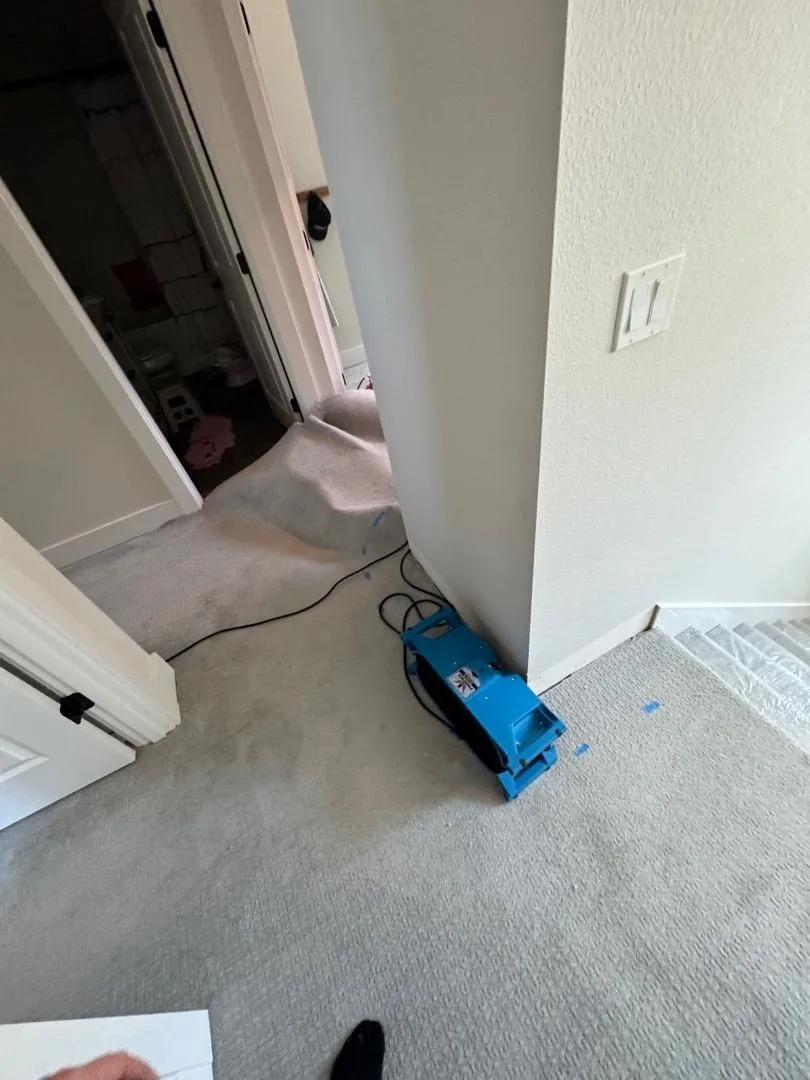
Air mover drying a hallway after an upstairs sink overflow in a Portland home

The project at a glance

Location
Portland, Oregon
Cause of loss
Upstairs sink overflow
Project type
Residential water damage
Mitigation opened
July 24, 2026
Areas affected
Multiple rooms, two levels
Job status
Emergency mitigation completed

Documented from TIK Construction job records. Customer details stay private — the work is what we show.

What happened

Sink overflows are the loss nobody takes seriously until they've had one. There's no burst pipe, no storm — just a faucet running into a blocked drain a few minutes too long. But water doesn't respect rooms. It finds every penetration in the floor — plumbing chases, vents, seams — and keeps moving down.

That's what happened here: the overflow started upstairs and the water traveled, wetting flooring and reaching areas on the level below before it was stopped. On overflows, the visible puddle is rarely the real loss — it's what soaked into the layers underneath that decides how big the job gets.

The loss entered our system on July 24, 2026 as an emergency water mitigation. Our crew documented every affected room, removed the flooring that couldn't be saved, and ran drying equipment until the structure hit dry standard. The mitigation is completed in our job file — and because our crews photograph their work, you're looking at the actual job on this page.
How the project ran

Dated from the job file — this is the actual sequence, not a brochure.

  1. July 24, 2026

    Emergency call — mitigation opened

    The loss came into our system as an emergency water job. First steps on an overflow: confirm the source is stopped, then trace how far the water actually traveled — which is always farther than it looks.

  2. Late July 2026

    Room-by-room moisture mapping and demo

    Every affected room was metered and photographed. Saturated flooring came out where it couldn't be dried in place, down to clean subfloor.

  3. Late July 2026

    Structural drying

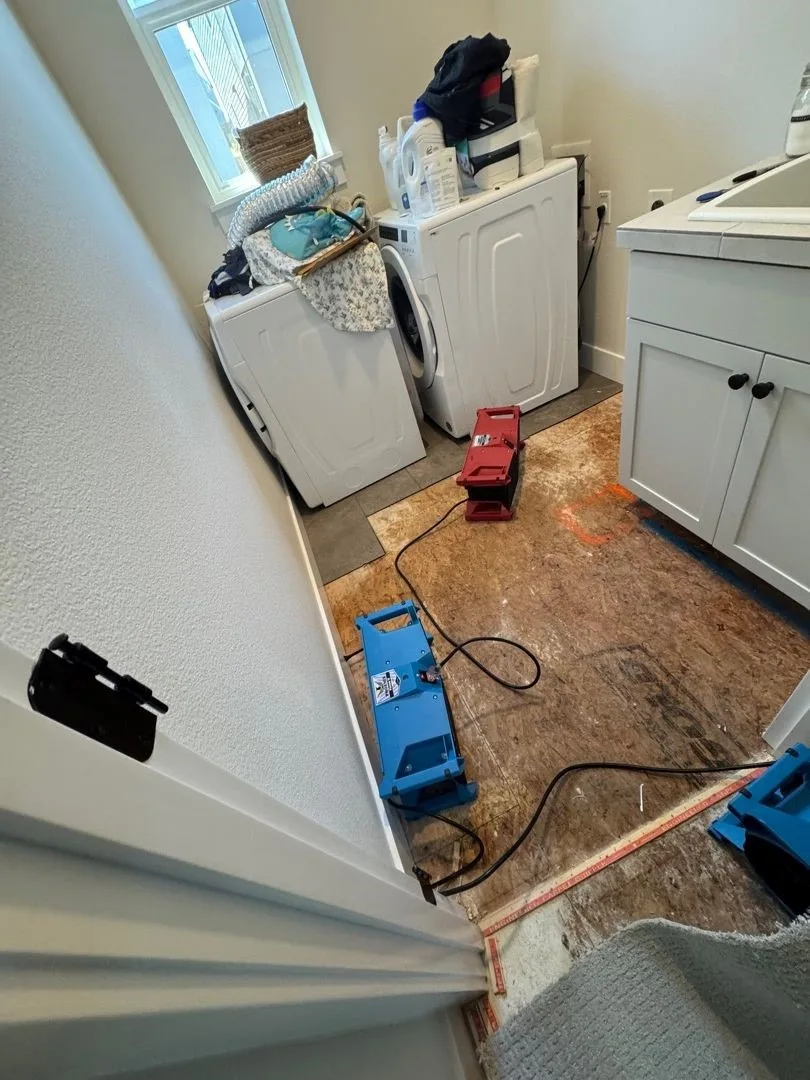
    Air movers and dehumidification ran across the affected areas — hallway, laundry, and adjoining rooms — with moisture readings logged until the numbers said dry.

  4. Job file

    Mitigation completed

    The emergency phase is completed in our records: water stopped, wet materials out, structure dried and documented.

Water moving through your Portland home right now? Call — we answer day or night.

Fast response across Clark County and the Portland metro.

The work, phase by phase

Phase 1 — Trace everything the water touched

Overflows punish shortcuts. Water that traveled through a floor system shows up rooms away from the sink, and any room that gets skipped in the assessment becomes next month's mold call. This job was mapped room by room with moisture meters before any demo decision was made.

Air movers running on exposed subfloor where saturated flooring was removed

Phase 2 — Remove what can't be dried, keep what can

Flooring that had water underneath it came out — you can see the exposed subfloor in the photos. Materials that metered dry or could be dried in place stayed. That balance is the whole craft of mitigation: taking out too little breeds mold, taking out too much inflates the rebuild.

Phase 3 — Dry it and prove it

Equipment placement isn't decoration — air movers push moisture out of framing and subfloor, dehumidifiers capture it. The crew logged readings daily until the affected assemblies hit dry standard, and that documentation is what protects the homeowner and the claim.

Why this matters

An overflow looks like the most minor water loss there is — no broken pipe, no storm. But water that travels through a floor system does hidden damage in places surface drying never reaches. The difference between a non-event and a mold problem is whether every wet room got found and dried the first time.

If a sink or tub overflows in your home

  • Stop the water, then look DOWN

    Once the faucet is off, check the rooms below — ceilings, light fixtures, walls. Water travels fast, and the damage below is usually worse than the puddle you can see.

  • Don't trust a dry-looking floor

    Flooring can look fine while the layers underneath are soaked. If water sat for more than a few minutes, the floor assembly needs to be metered, not eyeballed.

  • Move fast on gray water

    Sink water picks up whatever was in the drain. The longer it sits in flooring and framing, the worse the contamination and odor get — same-day response genuinely matters.

  • Photograph before you clean up

    Wide shots of every affected room, close-ups of standing water. If a claim is warranted, first-hour photos are your strongest documentation.

Real reviews

What homeowners say about working with TIK

5★ average from 50+ verified Google reviews

  • "After having a pipe burst in our rental home, TIK Construction and Restoration has done a phenomenal job mitigating the damage and communicating with us every step of the way. Elmer, their mitigation manager, has been especially thorough and precise to prevent any lasting damage to the home, and has been very thoughtful of protecting our belongings during this process. Isaac, another very nice gentleman and their director of operations, gave us a clear picture of what the whole process would look like and thoughtfully informed us of our options with our renter's insurance."

    Joel Jacobs

    Verified Google Review

  • "We called TIK when we woke up (on a weekend!) to a major leak in our living room from the upstairs tub. Elmer mobilized right away and got to us within a couple hours to begin the water mitigation. He is now helping us communicate with our insurance representative and take the next steps in the water restoration. We appreciate all the help we've gotten from TIK during this difficult event!"

    Grace D.

    Verified Google Review

  • "TIK Construction and Restoration did an amazing job restoring our home after a flood caused by a burst pipe upstairs. From start to finish, their team was professional, communicative, and easy to work with. They kept us informed throughout the entire process, answered all of our questions, and made what could have been a very stressful situation much smoother. The quality of their work really stood out—everything was done with attention to detail and care."

    Alex Volkov

    Verified Google Review

  • "Careful and skilled. I'm very happy with the workmanship of this job—reconstruction of main bathroom walls and floor after a flood. Enjoying my "new" bathroom in my 100-year-old house."

    S. Zane

    Verified Google Review

  • "TIK restored my laundry room after a leak damaged the flooring and walls. They did a fantastic job — above and beyond what was required. Always a good feeling to have things fixed right. Thank you TIK!"

    Ron Howard

    Verified Google Review

  • "Isaac and his crew did an outstanding job restoring our master bathroom! They were all very reliable, and professional and their workmanship was excellent! Isaac is an exceptional project manager. He took a lot of stress off our shoulders by providing guidance and resources for finding materials. He made regular visits to check up on the progress and to keep the project on track. The final project exceeded our expectations."

    Valorie Adler

    Verified Google Review

Questions homeowners ask about losses like this

How does a sink overflow cause this much damage?

An overflowing sink doesn't stay in its room. Water finds the floor penetrations — plumbing chases, duct openings, light fixtures — and travels into the framing and the rooms below. Ten minutes of unattended faucet can wet several rooms on two levels, which is exactly the pattern we see on losses like this one.

Is sink-overflow damage covered by homeowner's insurance?

An accidental overflow is typically treated as sudden and accidental water damage, which standard policies usually cover. Slow drips under a sink that rot the cabinet over months are a different category and often excluded. We document the loss to carrier standards either way.

Why do you remove flooring instead of just drying the surface?

Water that came from above has usually saturated the flooring layers and the subfloor beneath them. Drying the visible surface while the layers underneath stay wet is how homes end up with cupped boards, lingering odor, and mold. We take moisture readings through the assembly and remove only what can't be dried in place.

How long does drying take after an overflow?

Typically 3–5 days once wet materials are removed and equipment is placed — air movers to push moisture out of the structure, dehumidifiers to pull it out of the air. Equipment stays until logged readings hit dry standard, not until a calendar date.

Your home could be the next project we finish.

A real person answers day or night.

Available 24/7 · Day or night · Every day of the year

Not an emergency? Tell us what happened

Send your info and we'll call you right back, day or night.

For emergencies, call us directly: (971) 365-5108

Call Now: (971) 365-5108